May 22, 2019

Day one is done!

Room 208 is always great, but today it was also very quiet. 
Everyone worked so very hard on their booklets. The only sound you could hear was the sound of pencils writing away! 

For some children, it was a long day, but for others, the day flew by. Either way, everyone has earned extra dessert tonight! 


Typically, the boys and girls feel less nervous going into Day Two and then Day Three is a breeze. 

We're off to a terrific start and looking forward a bit of a break on Thursday.  

  
Thank you for bringing your children to school on time and for the large lunches you've packed. The students appreciated the good fuel for their minds and bodies! 

As we head into Day 2 on Friday, please don't hesitate to write a little note of encouragement to your child in the agenda.  


May 16, 2019

Math Makes Sense: Unit 9 Length, Area and Perimeter

We've begun our next Math unit! This is the last official unit of the year! After this unit, we'll be revisiting skills and problem solving using ALL the new stuff we've learned. For this final unit, the boys and girls will learn all about length, area and perimeter. 

What are the Big Ideas? 
  • The centimetre, the metre, and the kilometre can be used to measure the length, width, and height of an object.
  • Standard units of measure, such as the centimetre and the metre, are used to measure the perimeter of two-dimensional figures.
  • Uniform non-standard units can be used to estimate and measure perimeter and area.

How Will the Concepts Develop?

Students use metre sticks and rulers to explore standard units of measure. They measure the lengths, widths, heights, and perimeters of a variety of real world objects and they establish benchmarks for the standard units, the centimetre and the metre. 


Students use these benchmarks to estimate linear dimensions. 


After much practical experience, students will be better able to select the most appropriate unit to measure length.


Students measure and compare the perimeters of two-dimensional figures using standard units. They use non-standard units such as Pattern Blocks and paper squares, to cover a figure and measure its area.


Students find the areas of figures drawn on grid paper by counting squares and partial squares. Through exploration, students see that figures with the same area can have different perimeters.


Why Are These Concepts Important?


Measuring skills are practical skills students will use. Experience in measurement lays a foundation for the use of measuring tools and formulas that students will encounter in later grades. As their measuring skills improve, students should be able to solve increasingly complex measurement problems. These skills may be applied in other areas, such as science, art, and geography.


From: 

Math Makes Sense: Ontario Teacher's Guide 
Published by: Pearson Education Canada. 2004  

May 14, 2019

Success Checklist


I have created a very full list of things students need to know to feel confident and prepared for EQAO week in a week or so. 

This list will not be distributed in class, it's for study purposes only.  I'm asking that parents review each item with their child, check off what they know and then spend some time on those items that need revisiting. This is for your home-use only and is not to be returned to school. 

There are still a number items to cover in class on the checklist, so some material may be unfamiliar to students.


The checklist is to be used as a kind of study guide. You can formulate questions to ask your child based on this guide to be sure they are confident before you check off an item.  

I have indicated that "students should be able to check-off each item" on the checklist, but it should be a parent doing so.

While the big "E" isn't a test, kids understandably do feel nervous as it approaches. My hope is that by using this document as a guide, students will feel more confident when they see just how fully prepared they really are. 


Success Checklist

May 11, 2019

Knock, knock, hoo's there!


We've just wrapped up our two-week text of the week (TOTW) with our test last Friday. This text was all about owls and it's been a real hoot (groan) to use our text (An Eye Out For Owls) to talk about a non-fiction article can be presented as kind of a story.  

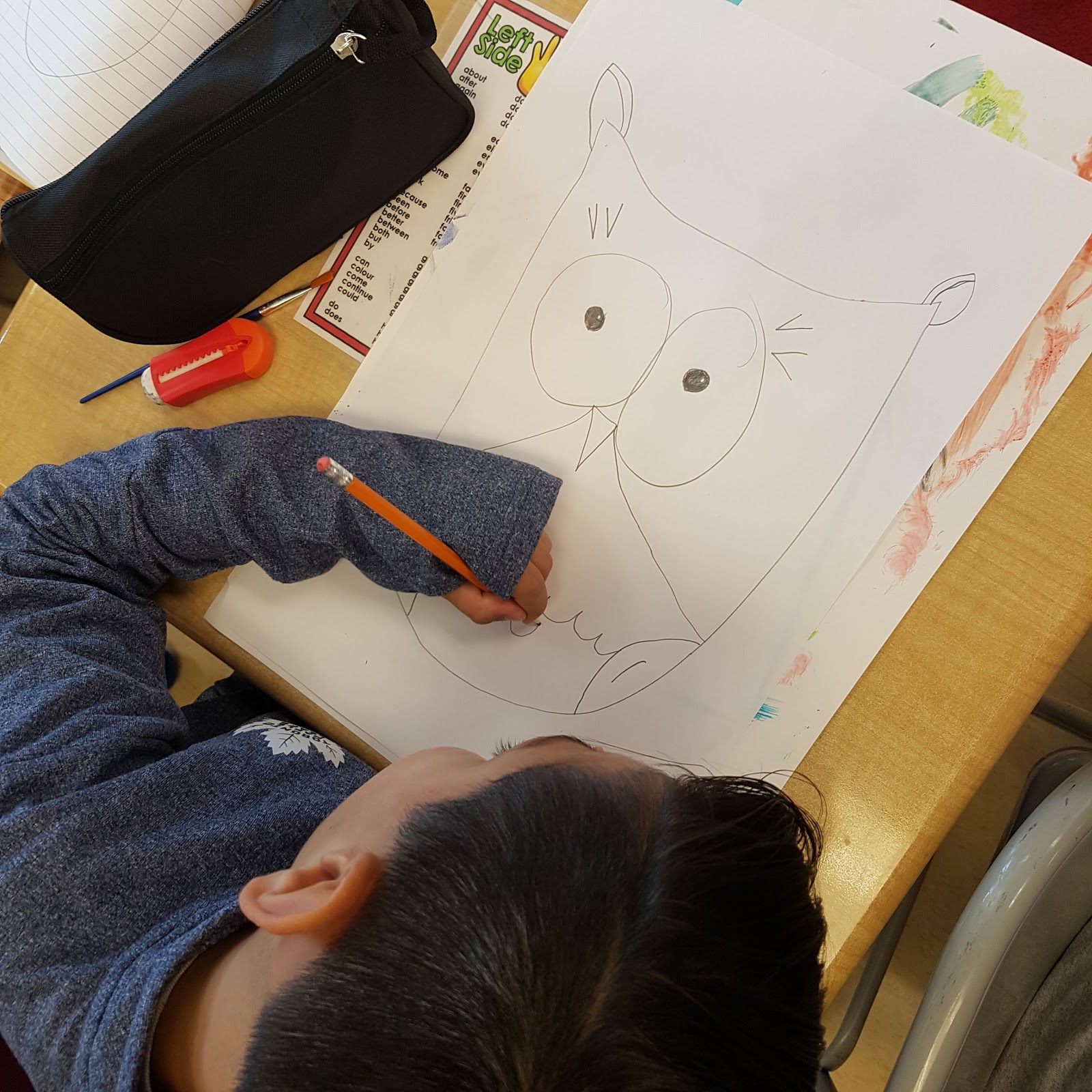
Not only have we used this text to help us prepare for the types of questions we can anticipate when writing EQAO, but we've done research, learned an adorable new song (we're hoping to make a video on Monday!) talked about idioms ("you're a real night owl")  and, as many parents and families already know, learned how to draw an owl (thank you for coming in on Monday to help!)! 


It's certainly been a great two-week study of these very interesting and mysterious creatures! 


As mentioned,  we had our text of the week test on Friday and, as you can see, one member of room 208 came dressed for the occasion!


If you'd like to try this directed drawing activity with your students, you can find the video I created below. There's no sound so that the video can be played on a loop in a large group setting. 


LinkWithin

Related Posts Plugin for WordPress, Blogger...